
A time bound account of sanctions disputed elections counter narcotics justification. And the January 2026 US air strikes on Caracas. […]

Republic Day is one of the most important milestones in the political and constitutional history of India. Observed annually on January 26, the day marks the enforcement of the Constitution of India in 1950, which replaced colonial-era governance and established India as a sovereign, democratic republic governed by the rule of law. In 2026, India observes its 77th Republic Day, representing more than seven decades of constitutional continuity. Republic Day is not a cultural or religious festival; it is a solemn national observance that commemorates the legal birth of the Indian Republic and the supremacy of its Constitution.
Unlike cultural or religious observances, Republic Day is not a festival of celebration. It is a solemn national occasion rooted in law, institutional continuity, and democratic responsibility. It represents the legal birth of the Indian Republic and affirms the supremacy of the Constitution as the highest authority of the nation. The day is fundamentally about governance by consent of the people, exercised through constitutional mechanisms rather than inherited power or external control.
At its core, Republic Day signifies the idea of a republic. In a republican form of government, the head of state is elected rather than hereditary, sovereignty rests with the people, authority flows from a written constitution, and the law applies equally to all citizens. Republic Day marks the precise moment when India ceased to function as a British dominion and became a self-governing constitutional republic, deriving all its legitimacy directly from its citizens
India gained independence from British colonial rule on August 15, 1947, ending nearly two centuries of foreign domination. However, independence did not immediately make India a republic. In the initial years following independence, the country continued to be governed under the Government of India Act, 1935, which was a colonial legal framework designed to serve imperial interests.
During this transitional period, the British monarch remained the symbolic head of state, represented in India by the Governor-General. Although political power was exercised by Indian leaders, the legal sovereignty of the state had not yet been fully transferred to the people. India functioned as a dominion within the British Commonwealth, lacking a constitution framed entirely by its own representatives.
True self-governance required more than political freedom. It required a comprehensive legal framework that reflected India’s values, addressed its diversity, protected individual rights, and defined the structure and limits of governmental power. This necessity led to the framing of the Constitution of India.
The choice of January 26 as Republic Day was not accidental; it was deeply rooted in the history of India’s freedom struggle. On January 26, 1930, the Indian National Congress adopted the Declaration of Purna Swaraj, or Complete Independence, at its Lahore session. This declaration unequivocally rejected British authority and asserted India’s right to full sovereignty.
Following this declaration, January 26 was observed as Independence Day by nationalists across the country from 1930 until 1947. It became a symbol of India’s aspiration for complete self-rule and political dignity. When the Constitution was finalized, the framers deliberately chose January 26, 1950 as the date of its enforcement to honour this historic declaration and to symbolically complete the long struggle for sovereignty.
Thus, Republic Day represents not only a constitutional milestone but also the fulfillment of a promise made during the freedom movement.
The idea of a Constituent Assembly to frame India’s constitution was first proposed in 1934 by M. N. Roy and later supported by the Indian National Congress. The Constituent Assembly was formally constituted in 1946, with members elected indirectly by provincial legislative assemblies. Despite the political turmoil of partition and the departure of some members representing areas that became part of Pakistan, the Assembly functioned as a broadly representative body.
The Constituent Assembly included leaders from diverse political backgrounds, regions, religions, castes, and languages. It reflected the plural nature of Indian society and undertook its task with remarkable seriousness. Over nearly three years, the Assembly engaged in extensive debates on governance, rights, federalism, minority protection, and social justice, laying the foundation for one of the most detailed constitutions in the world.
The Drafting Committee of the Constituent Assembly was chaired by Dr. B. R. Ambedkar, whose intellectual leadership left an indelible mark on the Constitution. Dr. Ambedkar emphasized constitutional morality, equality before law, protection of fundamental rights, abolition of untouchability, and the pursuit of social justice. His vision sought to correct historical injustices while ensuring democratic stability.
The drafting process took two years, eleven months, and eighteen days. During this period, the Assembly held numerous sessions and debated hundreds of articles. The Constitution drew inspiration from several international sources, including the British parliamentary system, the American Bill of Rights, the Irish Directive Principles, and the federal structures of Canada and Australia. However, these influences were adapted to India’s unique social, cultural, and political realities.
The Constitution was adopted on November 26, 1949, a date now celebrated as Constitution Day. Its enforcement was postponed to January 26, 1950, to align with the historical significance of the Purna Swaraj declaration.
On January 26, 1950, the Constitution of India came into force, marking a decisive transformation in the nature of the Indian state. The office of Governor-General was abolished, and India adopted the office of the President as the constitutional head of state. Dr. Rajendra Prasad became the first President of India, elected under the provisions of the new Constitution.
With this change, the British Crown ceased to have any authority over India. The transfer of power was complete, not merely in political terms but in legal and constitutional terms. India emerged as a republic in the true sense, governed by laws framed by its own people.
Republic Day symbolizes the supremacy of the Constitution and the principle that no individual or institution is above the law. It reinforces the idea that governmental authority is limited by constitutional provisions and that fundamental rights are enforceable against the state. Republic Day also highlights the balance between rights and duties, emphasizing responsible citizenship as the cornerstone of democracy.
The day reaffirms core constitutional values such as sovereignty, democracy, secularism, equality, justice, and the rule of law. These principles guide the functioning of the Indian state and provide stability in a society marked by immense diversity.
Republic Day is a civic observance rather than a festive celebration. Its purpose is educational, institutional, and symbolic. It seeks to promote constitutional awareness, respect for democratic institutions, and appreciation of national unity. The Republic Day Parade held at Kartavya Path in New Delhi is a formal state ceremony conducted under strict protocol. It demonstrates the authority of the Republic, civil-military coordination, and the orderly functioning of the Indian state.
The parade also serves as a visual representation of India’s unity in diversity, showcasing cultural heritage, administrative strength, and technological progress under constitutional governance.
On Republic Day, the President of India assumes a central ceremonial role as the constitutional head of the Republic and Supreme Commander of the Armed Forces. By taking the salute at the parade, the President symbolizes the supremacy of the Constitution and the principle of civilian control over the military. This reflects the democratic ethos of the Indian state, where armed forces operate under elected civilian authority.
In modern India, Republic Day remains critically relevant. It serves as a reminder that democracy requires discipline, institutions, and adherence to constitutional norms. In times of political polarization, social change, and rapid technological advancement, the Constitution acts as a stabilizing force. Republic Day encourages reflection on constitutional morality, accountability of power, and the responsibilities of citizenship.
The observance also plays a vital role in educating younger generations about India’s constitutional heritage, ensuring that democratic values are transmitted across generations.
Republic Day is the constitutional foundation of modern India. Observed every year on January 26, it commemorates the moment when India chose to govern itself through law, equality, and democratic principles rather than colonial authority or inherited power. As India observes its 77th Republic Day in 2026, the occasion serves as a reminder that independence is preserved not merely through historical memory, but through continuous commitment to constitutional values, democratic responsibility, and civic duty.
Republic Day is therefore not a celebration in the festive sense, but a national reaffirmation of India’s constitutional identity and the ideals upon which the Republic stands.
A time bound account of sanctions disputed elections counter narcotics justification. And the January 2026 US air strikes on Caracas. […]
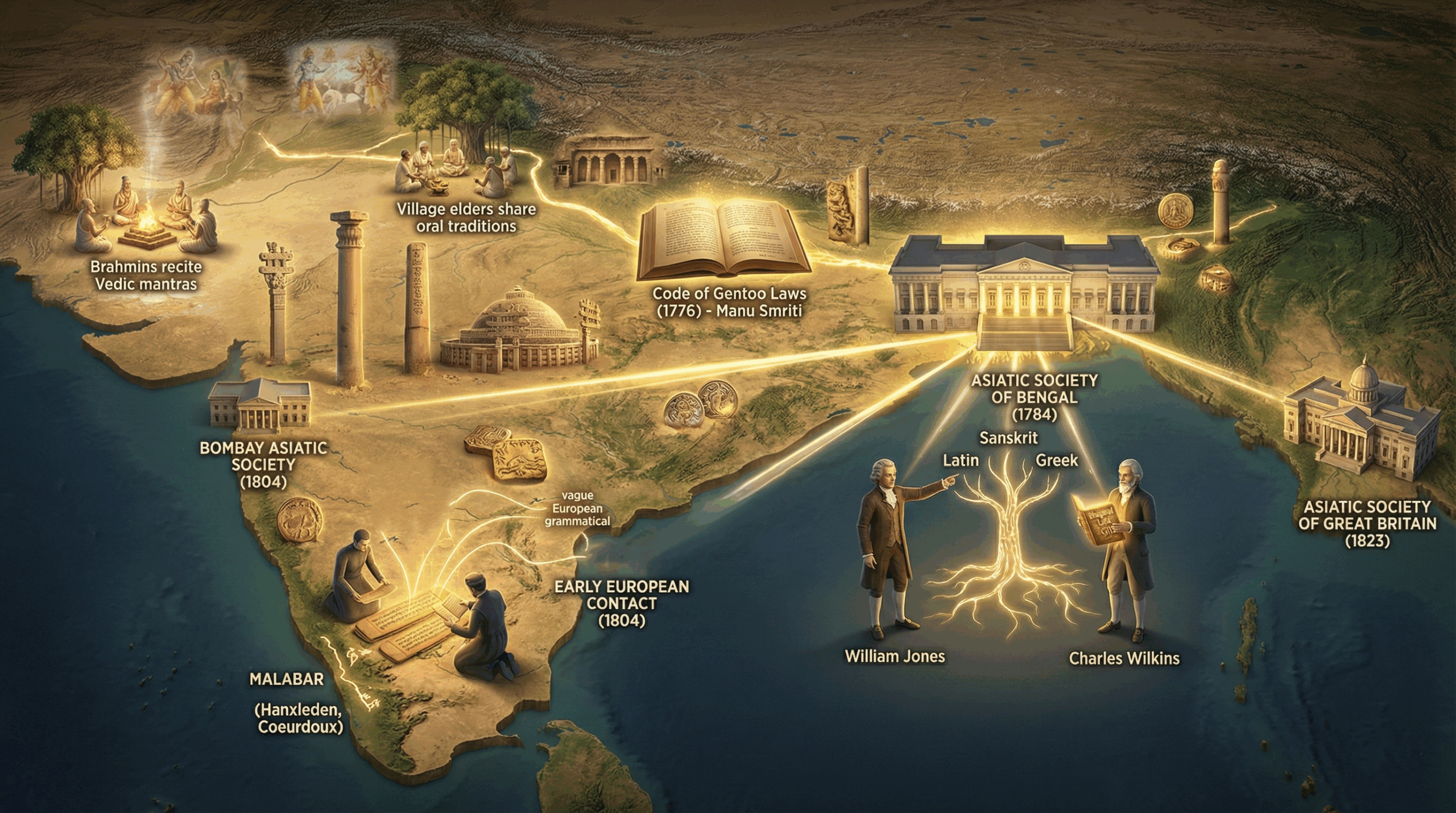
‘How the ancient history of India in modern times came to be noticed’ Introduction Ancient Indian civilization was unlike those […]

सोन और मद्रास उद्योग पाषाण काल के जिनके साक्ष्य भारत में अलग अलग जगहों पर पाए गये |