The human brain does not age along a single, uniform trajectory. Instead, brain ageing represents a spectrum of biological outcomes […]

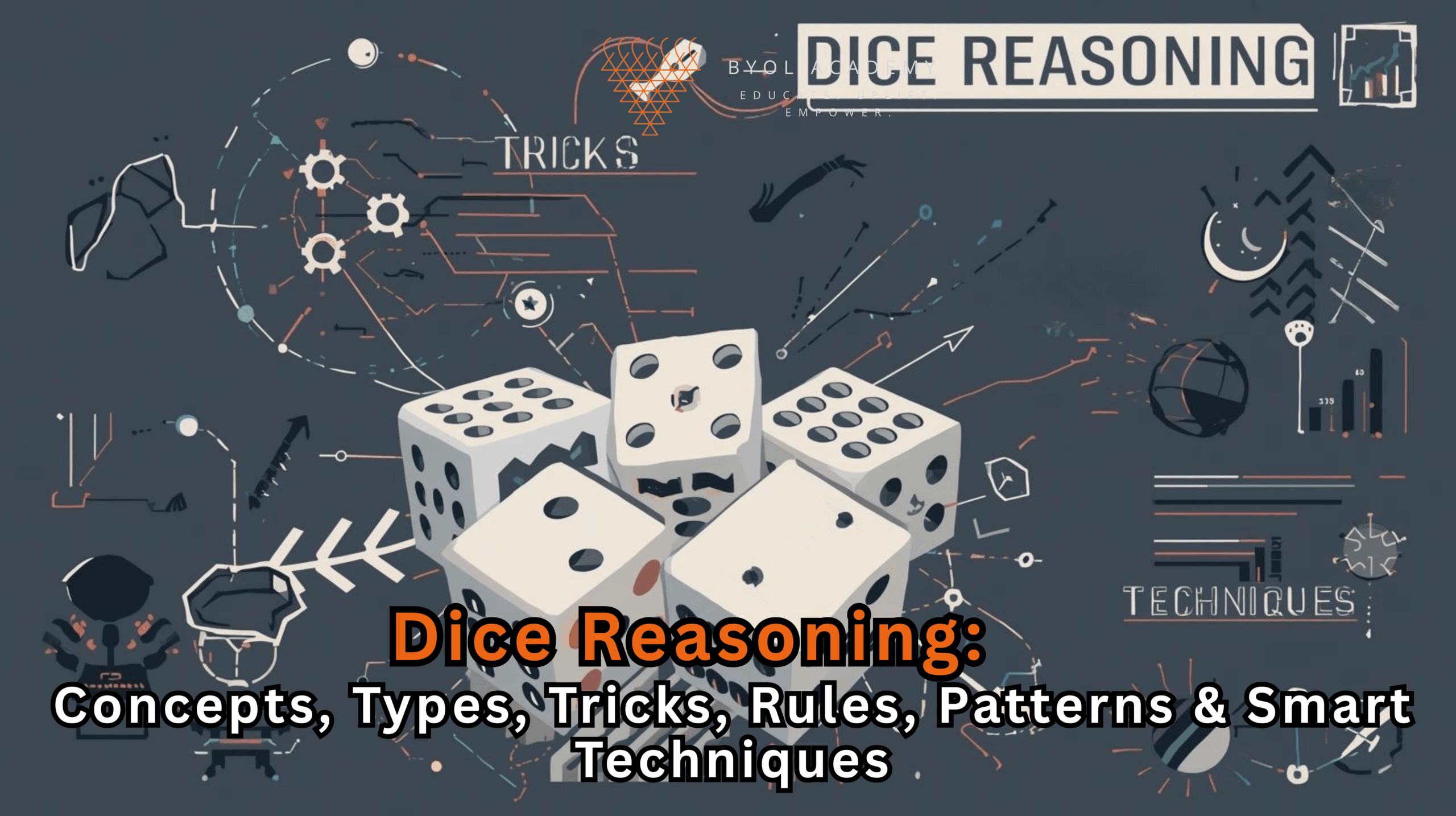
Reasoning is a crucial part of competitive examinations, aptitude tests, and everyday decision making. Among the many topics that form the foundation of logical reasoning, dice problems hold a special place. Dice based questions test a learner’s ability to visualise three dimensional objects, understand spatial rotation, and apply logical deduction. These problems appear frequently in exams such as SSC, Banking, Railways, Defence, CAT, and many international aptitude tests.
At first glance, a dice may look like a simple cube with numbered faces, but within the reasoning domain, it becomes a tool that evaluates how effectively a person can interpret, rotate, and compare 3D shapes. Dice reasoning questions not only improve intelligence and logic but also enhance cognitive speed and accuracy. This article aims to provide an in depth understanding of dice, their types, examples, real life applications, and the importance of mastering this unique topic.
A dice (or die) is a small cube typically used in games, consisting of six square faces, each marked with numbers or symbols. In reasoning, a dice refers to a 3D cube with markings, and the task usually involves evaluating the relationships between its faces.
In the context of reasoning ability, dice can be classified into several types. Understanding these types helps in identifying the logic behind exam questions:
A Standard Dice is a die where the sum of the numbers on the opposite faces is always equal to 7.
Opposite Pairs:
1 is opposite to 6 (1+6=7)
2 is opposite to 5 (2+5=7)
3 is opposite to 4 (3+4=7)
Identification: The sum of any two adjacent faces will not be 7.
Example:
Q1: If 3 is opposite 4, and 1 is opposite 6, which number is opposite 2?
Answer: 5 (because opposites add up to 7)
Q2: Standard Dice
In a standard dice, which number is adjacent to 6?
Options:
A. 1
B. 2
C. 3
D. 4
E. 5
Answer: All except 1. Because 1 is opposite 6.
A non-standard dice does not follow the rule of opposite faces summing to 7. The numbers or symbols can appear in any arrangement. Examinations often use such dice to test understanding of orientation rather than memorised rules.
Rules for Finding Opposite Faces (Ordinary Dice)
When two or more positions of the same die are given, you can use these rules:
Rule 1: One Common Face
If two different positions of a die show one common face, move clockwise or counter-clockwise from the common face in both diagrams. The faces that appear in the corresponding positions will be opposite to each other.
Example: If two dice show 3 as the common face, and the clockwise sequence is 3 \to 1 \to 5 in the first die and 3 \to 6 \to 2 in the second, then:
Rule 2: Two Common Faces
If two different positions of a die show two common faces, the remaining (uncommon) faces are opposite to each other.
Example: If two dice show 4 and 5 as common faces, and the first die shows a 1 and the second shows a 6, then 1 is opposite to 6.
Rule 3: Adjacent Faces
Any face adjacent to a given face cannot be opposite to it. If you see the faces A, B, C, D adjacent to face E, then the opposite face of E must be the one face that is not A, B, C, or D.
C. Open Dice (Net Dice)
An open dice or a dice net is a 2D unfolded representation of a 3D cube. The candidate must visualise how the arrangement will look once folded. Several standard net shapes exist, and familiarity with them is essential.
In Open Dice problems, the flattened out, two dimensional net of a die is given.
Opposite Faces: In an open die net, opposite faces are always separated by one face (they are at alternate positions in a row or column).
The face directly adjacent to two other faces will be opposite to the face on the other side of the middle adjacent face. For instance, in a common open dice format:
Example: Open Dice (Net Folding)
Question: If a dice net has the faces arranged as:
Which face is opposite to 6?
Solution:
By mentally folding the net:
→ 3 becomes the front face
→ 1 left
→ 5 right
→ 2 top
→ 4 bottom
→ 6 becomes the back face
Thus, the opposite of 6 is 3.
Answer:3
D. Coloured or Symbolic Dice
Dice reasoning does not always use numbers. Many exams and puzzles use colours, letters, or symbols on the faces of dice to test deeper spatial and logical reasoning. These types of dice help determine relationships between faces such as adjacent, opposite, and visible surfaces.
1. Coloured Dice
A coloured dice is a cube in which each face is painted with a different color instead of being numbered. The logic remains the same, but instead of digits, colors represent faces.
Why Coloured Dice Are Used?
To check if the candidate can identify patterns without relying on numerical relationships (like opposite faces summing to 7).
→ To test pure visual/spatial reasoning.
→ To make the cube more abstract and challenging.
Important Points
→ No opposite sum rule applies.
→ Only adjacency and non-adjacency matter.
→ You must compare multiple views to find opposite faces.
Example Question (Coloured Dice)
Two views of a coloured dice are given:
→ View 1: Blue is adjacent to Red and Yellow.
→ View 2: Red is adjacent to Green and Yellow.
Question: Which colour is opposite Blue?
Solution: Blue touches (is adjacent to):
Red and Yellow
In second view, Red touches:
Green and Yellow
Since Green does not appear with Blue in any adjacency, it is likely the opposite of Blue.
Answer: Green
2. Symbol Dice
A symbol dice uses symbols (letters, shapes, signs) instead of numbers or colours. Examples include:
*, #, @, %
A, B, C, D
Arrows, dots, patterns
These questions test the ability to analyse faces without numerical clues.
→ Why Symbol Dice Are Used?
→ To focus on logical arrangement.
→ To remove any predictive pattern (unlike numbers or colours).
→ To increase the difficulty level.
Important Points:
You must observe common faces in different orientations.
The symbol that does NOT appear adjacent to a given symbol is its opposite.
Example Question (Symbol Dice)
Two views of a dice are shown:
View 1: @ is between # and %
View 2: % is between & and @
Question: Which symbol is opposite # ?
Solution: From first view→ touches @ and %
From second view→ % touches & and @
Thus, the face NOT touching # is: &
So, & is opposite to #.
Answer: &
Combined Examples (Colour + Symbol)
Sometimes exam questions use both colours and symbols on the dice.
Example: A dice has faces marked as:
Red ★
Blue ●
Green ▲
Yellow ■
Purple ♦
Orange ♣
You may be asked:
“Which symbol is opposite the ★ symbol?” or
“Which colour is opposite Yellow?”
These can be solved by analysing adjacency patterns from the given views.
Tips to Solve Coloured and Symbol Dice Problems
E. Comparative Dice
Comparative Dice refers to a type of dice reasoning where two or more dice are shown in different orientations, and you must compare the common faces to determine:
Relationship between symbols, numbers, or colours
This is one of the most frequently asked dice topics in competitive exams.
1. What Are Comparative Dice?
In comparative dice questions:
→You are given two or more views of the same dice.
→Each view shows different faces.
→Your job is to compare common faces and find which number/colour/symbol is opposite which.
Key Idea:
If a face appears in both dice, but it is adjacent to different faces, those adjacent faces cannot be opposite each other.
This helps us find the opposite pair.
2. Rules for Comparative Dice
Rule 1: If a common face keeps the same position in both views → direct comparison is possible.
Rule 2: If a common face is adjacent to different faces in two views, those faces are never opposite.
Rule 3: When comparing:- Identify one common face in both views.
Fix it mentally.
→Rotate the second dice mentally so the common face overlaps.
→Then check positions of other faces
3. Example Questions (with solutions)
Example 1: Two Numbers in Common
View 1: Shows → 1, 2, 3
View 2: Shows → 1, 4, 5
Question: Which number is opposite 2?
Solution:
→Common number = 1
→Compare faces around 1:
→In view 1: 1 touches 2 and 3
→In view 2: 1 touches 4 and 5
→So 2 cannot be adjacent to 4 or 5.
Among the faces not touching 2, the only possible opposite face is: 5
Answer: 5
Example 2: Only One Common Face
Dice 1: shows 3, 4, 5
Dice 2: shows 3, 6, 1
Solution:
Common face → 3
→Around 3 in dice 1: 4 and 5
→Around 3 in dice 2: 6 and 1
→Opposite pairs form from unmatched values.
→So 4 is opposite 1 and 5 is opposite 6.
Answer: Opposite of 4 → 1 and Opposite of 5 → 6
Example 3: No Common Face, Trick Case
If two dice have no common face, the question is often about top/bottom assumptions or gets info from a third view.
Example:
Dice A: 1, 2, 3
Dice B: 4, 5, 6
Since no face is common, direct comparison is impossible unless extra views are provided.
4. Comparative Dice (Colour or Symbol)
Example: Symbol Dice
View 1: @ between # and %
View 2: @ between * and &
Solution:
Common face = @upsc
→Adjacent faces change
→and * are never opposite @upsc
→% and & are never opposite each other.
Thus, the only remaining pair becomes: Opposite of # = &
Shortcut Tricks for Comparative Dice:
6. Practice Questions
Q1. View 1 → 2, 3, 6
View 2 → 3, 5, 1. Find opposite of 6.
Solution:
→Common face = 3
→Adjacent to 3 in view 1: 2, 6
→Adjacent to 3 in view 2: 5, 1
6 cannot be opposite 2 or 3 or anyone adjacent to 3.
Therefore opposite of 6 = 1
Answer: 1
Q2. View 1 → Red, Blue, Green
View 2 → Blue, Yellow, White. Opposite of Green?
Solution:
→Common face = Blue
→In view 1 Blue touches Red + Green
→In view 2 Blue touches Yellow + White
→Green cannot be adjacent to Yellow or White → opposite pair must be: Green ↔ White
Answer: White.
F. TRICK DICE:( Mirror Dice & Rotated Dice)
Trick dice questions purposely confuse you by showing the same dice in different orientations:
→Mirror view
→Rotated view (90°, 180°, 270°)
→Flipped view
MIRROR DICE:-
A mirror dice is a reflection, not a rotation.
In a mirror image:
→Left ↔ Right is swapped
→Top, bottom, and depth stay same
→Order of faces reverses.
MIRROR RULE (Very Important)
If the order of faces reverses, the dice is mirrored: NOT rotated.
But opposite faces DO NOT change in a mirror. Opposites remain the same.
This mistake causes 90% of exam errors.
Mirror Dice Example:-
View 1:
@
# %
View 2:
@
% #
→Order of (#, %) reversed → Mirror Dice.
→Opposite of @?
→Mirror does not change opposite relationships.
→Hidden faces remain same → opposite of @ is the face not shown in either view.
ROTATED DICE:-
A rotated dice is the SAME dice turned around no reflection.
Rotation changes visible arrangement
but not:
If order stays same, but positions shift → rotation.
1. Example of Rotation
View I:
A
B C
View II (rotated clockwise):
B
C A
Here order (A → B → C) is preserved, only direction changes.
ROTATION RULE
→If three faces maintain the same clockwise/anti-clockwise order,
→it is a rotated dice.
→If the order reverses → it is a mirror dice.
DIFFERENCE BETWEEN MIRROR & ROTATED DICE:-
| Feature | Mirror Dice | Rotated Dice |
| Left ↔ Right | Swaps | Does NOT swap |
| Order of faces | Reverses | Remains same |
| Opposites | Unchanged | Unchanged |
| Adjacency | Same | Same |
| Easy to identify | Yes | Yes |
| Confusing? | Very! | Moderate |
SHORTCUT TRICKS:-
TRICK 1: Left ↔ Right Swap = Mirror Dice
If only the horizontal direction swaps → Mirror.
TRICK 2: If order reverses → Mirror
(A → B → C) becomes (C → B → A) → Mirror.
TRICK 3: If order same but rotated → Rotation
(A → B → C) becomes (B → C → A) → Rotation.
TRICK 4: Opposites NEVER change in mirror or rotation.
TRICK 5: Faces seen together can never be opposite.
TRICK 6: Faces never seen together → likely opposite.
SOLVED EXAMPLES (Very Important)
Example 1- Identify Mirror vs Rotation
View 1:
2
3 5
View 2:
2
5 3
Order (3,5) → (5,3) reversed.
This is Mirror Dice. Opposite of 2 remains same.
Example 2: Rotated Dice
View 1: Shows → 1, 2, 3
View 2: Shows → 2, 3, 6
Common face = 2
Order (1 → 2 → 3) → becomes (3 → 2 → 6)
Order preserved → rotated.
To find opposite of 1: Faces never appearing together → 1 and 6 → opposite.
Opposite of 1 = 6
Example 3: Symbol Mirror Dice
View A: $
@ #
View B:
$
# @
Reversed → Mirror. Opposite of $?
The hidden face.
Opposite of $ = the face NOT shown in either view.
Example 4: Rotated Colour Dice
View A: Red, Blue, Yellow
View B: Blue, Yellow, Green
Order preserved → rotation.
Common face → Blue
Around Blue: In A: Red + Yellow
In B: Yellow + Green
Faces not matching adjacency → Red ↔ Green → Opposites.
Some questions related to exams:-
Here’s an example of dice which is commonly ask in exam
Q1: A Standard Dice Question:
A standard dice has 6 faces numbered from 1 to 6. If the dice is rolled once, what is the probability of getting:
1. An even number?
2. A number less than 5?
Solution:
1. Even numbers on a dice = {2, 4, 6}
Total possible outcomes = 6
Probability = Number of favorable outcomes ÷ Total outcomes = 3 ÷ 6 = 1/2
2. Numbers less than 5 = {1, 2, 3, 4}
Probability = 4 ÷ 6 = 2/3
Q2: In the following dice, the faces 1, 2, and 3 are adjacent to each other. Which number will be opposite 2?
Explanation: In any dice, if three numbers appear on adjacent faces, they cannot be opposite to one another. Here, 1, 2, and 3 are adjacent. That means:
→Opposite of 1 must be one of {4, 5, 6}
→Opposite of 2 must be one of {4, 5, 6}
→Opposite of 3 must be one of {4, 5, 6}
Using the rule that opposite faces cannot be adjacent, number 2 will have an opposite among the remaining set.
If a diagram shows 1 opposite 6, and 3 opposite 4, then automatically 5 becomes the face opposite 2.
Answer: 5
2: Comparing Two Dice
Q3: Two views of a dice are shown below:
In the first view, 3 is opposite 5.
In the second view, 3 is opposite 1.
Which number is opposite 1?
Solution:
Since 3 cannot be opposite to two faces simultaneously, the only possibility is that the second view shows the dice after rotation. This means:
3 opposite 5
Therefore, 1 cannot be opposite 3
So 1 must be adjacent to 3
By comparing the two images, we deduce that 5 is opposite 1.
Answer: 5
5. The Use of Dice in Real Life
Dice are small, typically cube-shaped objects with numbers or symbols on their faces, used for generating random outcomes. While most people associate dice with board games, their applications extend far beyond entertainment. Dice have been a part of human culture for thousands of years, and even in today’s modern world, they remain relevant in many practical scenarios.
1. Gaming and Entertainment
The most obvious use of dice is in games. From traditional board games like Ludo, Monopoly, and Snakes & Ladders to modern tabletop role-playing games such as Dungeons & Dragons, dice are essential for introducing randomness. They make games unpredictable, fair, and exciting, ensuring that no two games are ever exactly the same.
Dice are also used in gambling and casinos. Games like craps depend entirely on dice rolls. In such cases, dice provide an element of chance that is crucial for betting games, influencing outcomes and winnings.
2. Decision Making
In real life, dice can be used as a simple decision-making tool. For example, when two or more people cannot decide on a choice such as who will start a task, pick a menu item, or choose a team rolling a dice introduces randomness and fairness into the decision-making process.
Some people even use dice for personal life choices. For example, a dice roll might determine whether someone goes for a walk, works on a project, or takes a break. This might sound unusual, but it can help break indecision and reduce overthinking.
3. Teaching and Education
Dice are widely used as educational tools. Teachers use them to make learning interactive and fun. Some examples include:
Mathematics: Teaching probability, counting, addition, subtraction, multiplication, and even fractions using dice.
Language Learning: Assigning words or tasks to numbers on a dice to make exercises engaging.
Critical Thinking: Using dice for reasoning games where students must predict outcomes or solve puzzles.
This hands on approach helps students understand abstract concepts like chance, probability, and statistics in a practical, visual manner.
4. Probability and Research
Dice are fundamental in teaching and understanding probability theory. Statisticians and researchers often use dice in experiments and simulations to study randomness. For example: Simulating Random Events: Rolling dice repeatedly can help model random events, which is useful in statistics or computer simulations.
Game Theory and Decision Analysis: Dice help in testing strategies under uncertain conditions.
Behavioral Research: Dice are sometimes used in psychology experiments to study decision-making under risk and uncertainty.
5. Creativity and Storytelling
Dice are also used in creative fields, especially in role-playing games (RPGs) and storytelling exercises. For instance:
In RPGs, different dice determine the outcome of a character’s actions, adding excitement and unpredictability.
Writers and educators sometimes use dice to generate random story elements, such as character traits, plot twists, or settings, which fosters creativity and improvisation.
6. Technology and Simulations
In modern times, virtual dice are used in computer games, apps, and online learning tools. The randomness generated by digital dice is essential for fair gaming and simulations in software development. Even in artificial intelligence and machine learning, dice-like randomisation concepts are applied for testing algorithms and simulating real-world uncertainty.
7. Therapeutic and Recreational Use
Dice are sometimes used in therapy or mindfulness exercises. Rolling dice can be a simple way to break repetitive thought patterns or practice decision-making. In recreational therapy, dice-based games help improve hand-eye coordination, cognitive skills, and social interaction.
In essence, dice are not just tools for fun they are instruments of learning, experimentation, and creativity, proving that even small objects can have a significant impact on real-world activities.
While dice are often associated with board games, the reasoning behind dice has much broader real-life applications:
6. Why It’s Important
A. Enhances Spatial Intelligence
Dice reasoning strengthens the ability to visualise objects beyond their immediate orientation. This skill is vital in STEM fields.
B. Common in Competitive Exams
Almost every major aptitude test includes dice problems. Mastering it can significantly boost scores.
C. Improves Problem-solving Skills
Dice questions require:
Deduction
Comparison
Logical linking
These are essential skills in analytical thinking.
D. Supports Cognitive Flexibility
Interpreting dice from various angles trains the brain to switch between perspectives easily.
E. Foundational for Higher-level Reasoning
Topics such as cube counting, paper folding, and mirror images build upon the concepts learned in dice problems.
7. Closing Statement
Dice, though small and simple in appearance, hold immense value in the world of reasoning. They are powerful tools for measuring one’s mental flexibility, logical deduction, and three-dimensional visualisation skills. For students preparing for competitive exams or professionals looking to strengthen their analytical ability, dice-based reasoning offers an engaging and intellectually stimulating way to improve cognitive performance.
8. Conclusion
Dice are more than just gaming instruments; they are profound tools for evaluating spatial intelligence and logical reasoning. This article explored dice definitions, types, examples, real life applications, and their importance in reasoning. Whether you are a student, educator, or professional, understanding dice enhances your ability to think critically, interpret visual information, and solve complex problems efficiently.
Mastering dice is not only beneficial for exams but also for overall cognitive development. With practice, anyone can improve their spatial reasoning skills and boost their confidence in tackling reasoning challenges.
The human brain does not age along a single, uniform trajectory. Instead, brain ageing represents a spectrum of biological outcomes […]
Human social interaction depends on the ability to infer emotional states that are never directly observable. Unlike basic sensory perception, […]

Liver cancer is one of the fastest-rising causes of cancer-related deaths worldwide, closely tracking the global surge in obesity, metabolic […]