
Introduction Physical activity is essential for students to maintain a healthy body, sharpen their minds, and manage stress. Two popular […]

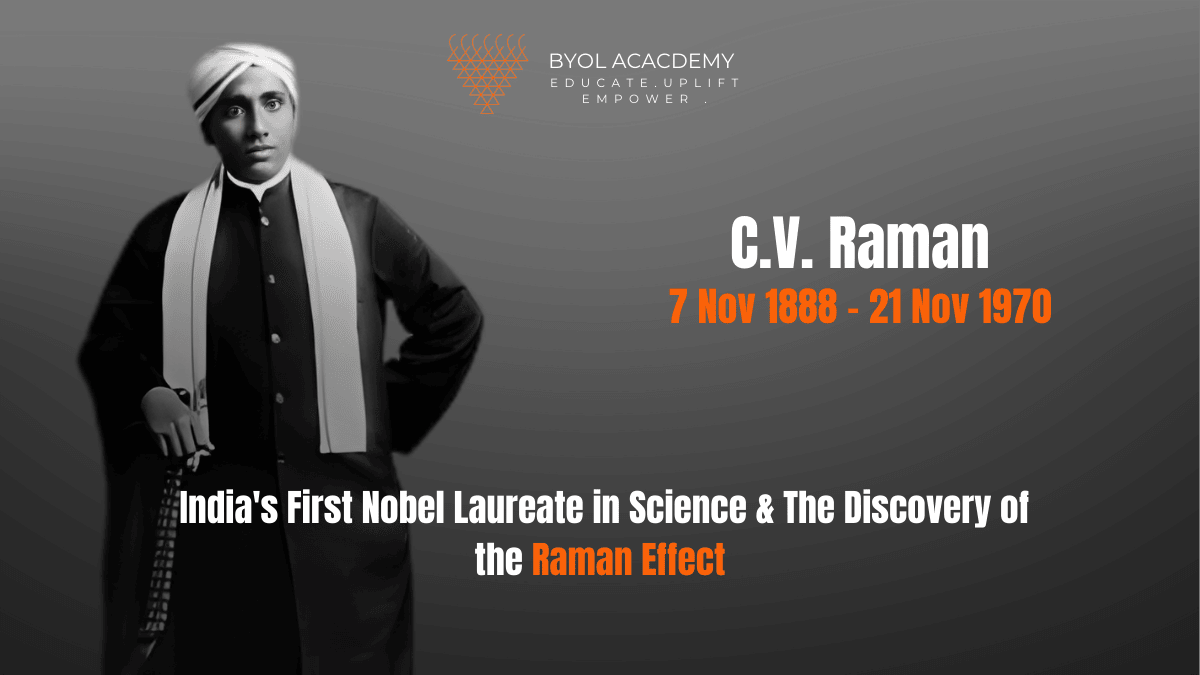
India has been home to many great scientists, but Sir Chandrasekhara Venkata Raman, popularly known as C.V. Raman, holds a distinctive position in history. He was the first Indian to win a Nobel Prize in Science, as well as the scientist whose discovery-the Raman Effect– changed the face of physics forever. His work opened new pathways in spectroscopy, material science, chemistry, and even astronomy. For students preparing for competitive exams or anyone curious about India’s scientific journey, C.V. Raman’s story is deeply inspiring.
C.V. Raman was born on 7 November 1888 in Tiruchirappalli in Tamil Nadu. Since his childhood, he was deeply fascinated with science and mathematics. His father, a lecturer in mathematics and physics, played the major role in nurturing Raman’s curiosity.
He finished his schooling quite early and entered Presidency College, Madras, when he was barely 13 years old. Raman was brilliant in academics and topped all university examinations, bagging a gold medal in physics.
Although an ardent lover of science, Raman joined the Indian Finance Department in 1907 because the scope of scientific research in India was poor. But he did not let his love for research diminish. At early morning and evening hours, he would conduct experiments at the Indian Association for the Cultivation of Science (IACS) in Kolkata where he eventually made his historic discoveries.
While studying the scattering of light, Raman noticed something peculiar. A fraction of the light, while passing through a transparent medium, changes its wavelength. This phenomenon had never been explained before.
After years of experiments, Raman published his findings in 1928, which would later come to be known as the Raman Effect.
It is the change in wavelength that takes place when light interacts with molecules within a medium. This phenomenon aids scientists in probing the chemical composition and the structure of the molecules of substances. Nowadays, it finds broad applications in:
The importance of this discovery was so huge that Raman received the Nobel Prize in Physics in 1930, making him the first Asian to get a Nobel in any branch of science.
C.V. Raman strongly believed that India needed to establish its own scientific base. His contributions towards developing the institutions of science are immense.
This was the place where most of his pioneering research had been carried out by Raman. He revived the institute and inspired young scientists to take up experimental physics.
Raman was an astute director and the head of the physics department. His main emphasis was on practical research and innovation.
In 1948, Raman established the RRI in Bengaluru to promote advanced scientific study. Even after leaving formal positions, he continued guiding young researchers here.
Through these institutions, Raman helped create an ecosystem of research and innovation in India long before independence.
What is truly inspiring about C.V. Raman is not his discoveries, but rather his personality and values.
The story of Raman seeing the blue sea during his voyage and wondering “Why is the sea blue?” reminds us that even everyday observations can result in huge scientific breakthroughs when curiosity is alive.
The Raman Effect is not only of historical importance but is also a basis for many contemporary scientific applications.
It identifies an unknown substance with the help of Raman spectroscopy.
It is used in cancer detection and in pharmaceutical testing.
It helps analyze crime scene materials such as fibres, powders, and drugs.
Raman spectrometers are part of missions to explore the Moon and Mars.
Modern Indian missions including Chandrayaan-3 and Mangalyaan also apply principles of spectroscopy discovered by Raman.
His contribution indirectly helped and lead to India’s growth in advanced scientific missions.
C.V. Raman received several awards and honors, including:
Many institutions and awards bear his name, such as:
Even today, Raman is studied by school and college students as a scientist and a role model of the scientific potential of India.
Raman’s life teaches four important lessons to UPSC, SSC, Railways, State PSC aspirants, and other competitive exams aspirants:
Great discoveries begin with simple questions.
With very basic equipment, Raman made world-changing discoveries.
Raman proved Indian science could shine globally.
He trusted his intuition even when global scientists doubted him.
His story motivates students to pursue excellence with dedication.
C.V. Raman represents an exemplary journey wherein passion, discipline, and curiosity weave magic into the world. From a boy fascinated by light to India’s first Nobel Laureate in Science, Raman proved that true greatness came from pursuing knowledge relentlessly.
His discovery of the Raman Effect continues to shape modern science, and his values continue to inspire millions of students preparing for competitive exams. Raman’s life reminds us that India’s scientific future is bright — and every student has the potential to contribute to it.
Introduction Physical activity is essential for students to maintain a healthy body, sharpen their minds, and manage stress. Two popular […]

The American Society for Radiation Oncology (ASTRO) has released its inaugural, evidence-based clinical guideline addressing the use of radiation therapy […]

Pregnancy is a remarkable biological phenomenon, not only because it sustains the development of a new life, but also because […]