Human social interaction depends on the ability to infer emotional states that are never directly observable. Unlike basic sensory perception, […]

Parkinson’s disease (PD) is a chronic, progressive neurodegenerative disorder that primarily affects the extrapyramidal motor system and is increasingly recognized as a multisystem neurodegenerative disease. It is the second most common neurodegenerative disorder after Alzheimer’s disease and represents a major cause of disability in the aging population. First described in 1817 by James Parkinson in “An Essay on the Shaking Palsy”, the disease has since become one of the most intensively studied neurological disorders due to its rising global prevalence and complex biology. Clinically, PD is characterized by bradykinesia, rigidity, resting tremor, and postural instability, along with a wide spectrum of non-motor symptoms including autonomic dysfunction, sleep disturbances, cognitive impairment, mood disorders, and sensory abnormalities.
From a neuropathological standpoint, Parkinson’s disease is defined by two cardinal features: (1) selective degeneration of dopaminergic neurons in the substantia nigra pars compacta and (2) the presence of Lewy bodies and Lewy neurites within surviving neurons. Over the past three decades, overwhelming evidence has identified alpha-synuclein as the principal molecular constituent of Lewy bodies, placing alpha-synuclein misfolding and aggregation at the center of Parkinson’s disease pathogenesis.
Alpha-synuclein is a 140-amino-acid protein encoded by the SNCA gene located on chromosome 4q21. It is abundantly expressed in the central nervous system, particularly at presynaptic terminals. Structurally, alpha-synuclein is classified as an intrinsically disordered protein, meaning it lacks a stable three-dimensional structure under physiological conditions. This intrinsic flexibility enables alpha-synuclein to interact dynamically with synaptic vesicle membranes, phospholipids, and multiple synaptic proteins.
Physiologically, alpha-synuclein plays a role in:
Importantly, knockout studies suggest that alpha-synuclein is not essential for neuronal survival, implying that its pathological effects in PD arise primarily from a toxic gain of function rather than loss of its normal physiological role.
The causal role of alpha-synuclein in Parkinson’s disease was definitively established through the discovery of rare familial forms of PD associated with mutations in the SNCA gene. Missense mutations, such as A53T, A30P, and E46K, alter the structural properties of alpha-synuclein, increasing its propensity to misfold and aggregate. Additionally, duplication or triplication of the SNCA gene results in increased alpha-synuclein expression and causes autosomal dominant Parkinson’s disease with early onset and rapid progression.
These genetic observations provided critical proof that abnormal alpha-synuclein alone is sufficient to cause Parkinson’s disease. However, it is crucial to recognize that the vast majority of Parkinson’s disease cases are sporadic, and most patients do not harbor SNCA mutations. Despite this, nearly every case of Parkinson’s disease demonstrates abnormal accumulation of alpha-synuclein, indicating that alpha-synuclein pathology represents a final common molecular pathway in both genetic and sporadic PD.
Under pathological conditions, alpha-synuclein undergoes conformational changes that shift it from a soluble, monomeric state to misfolded species with increased beta-sheet content. This misfolding initiates a hierarchical aggregation process:
These fibrils are structurally stable and resistant to degradation by cellular protein quality-control systems. Multiple factors promote alpha-synuclein misfolding, including oxidative stress, mitochondrial dysfunction, impaired autophagy-lysosomal pathways, aging-related proteostatic failure, and environmental toxins.
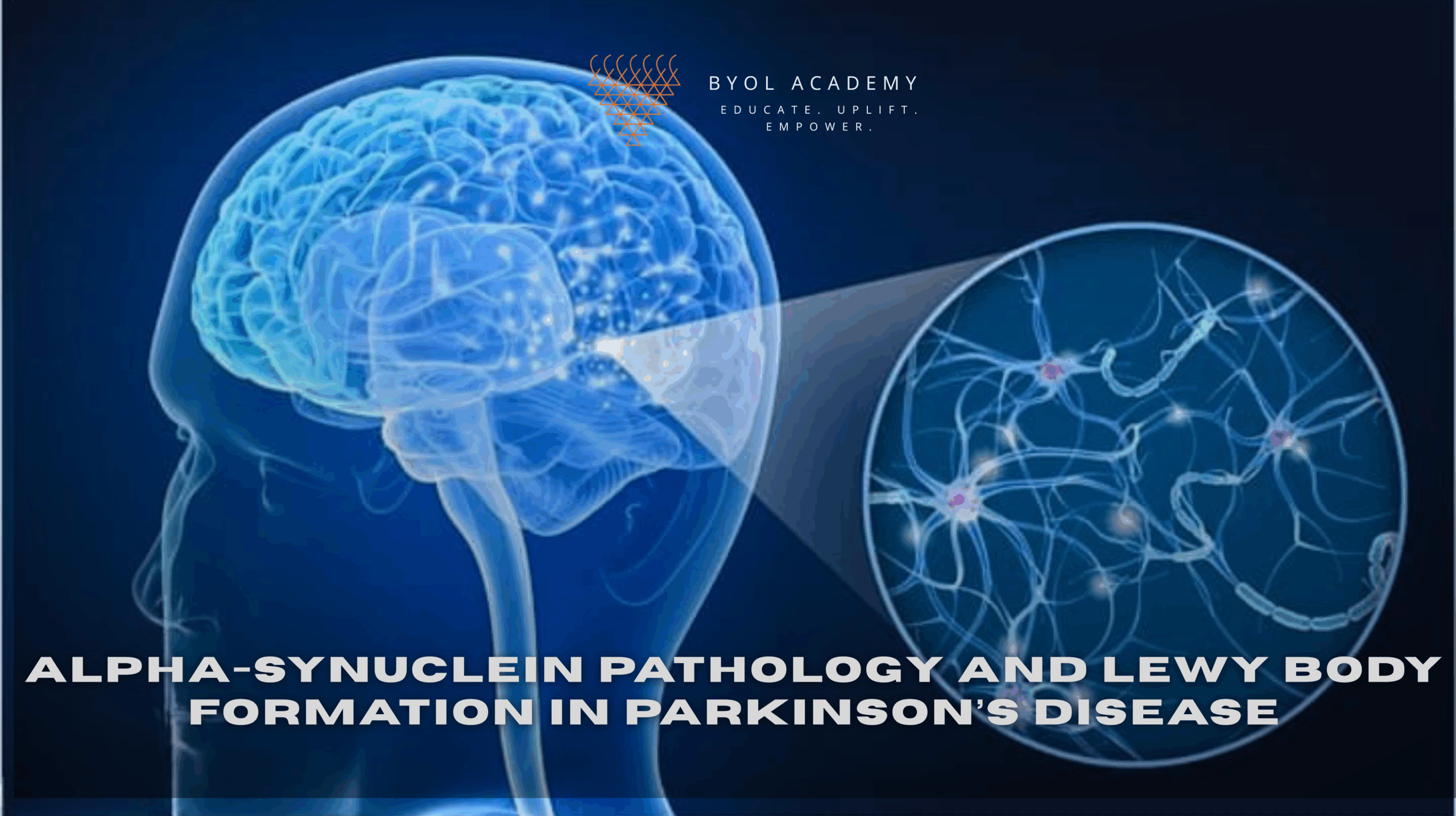
Lewy bodies are intracytoplasmic neuronal inclusions composed predominantly of aggregated alpha-synuclein fibrils, along with ubiquitin, neurofilament proteins, lipids, mitochondrial remnants, and other cellular components. On histopathological examination, Lewy bodies appear as eosinophilic, spherical inclusions with a dense core and a peripheral halo.
Lewy bodies are most prominently observed in the substantia nigra, accounting for the loss of dopaminergic neurons and the classical motor symptoms of Parkinson’s disease. However, they are also found in multiple other brain regions, including the locus coeruleus, dorsal motor nucleus of the vagus, olfactory bulb, limbic structures, and cerebral cortex. This widespread distribution explains the prominent non-motor manifestations of PD and underscores that Parkinson’s disease is a diffuse neurodegenerative process rather than a purely motor disorder.
The presence of Lewy bodies is considered the pathological hallmark of Parkinson’s disease and related disorders collectively termed synucleinopathies, which include dementia with Lewy bodies and multiple system atrophy.
Although Lewy bodies were first described over a century ago, their precise role in neuronal degeneration remains incompletely understood. Two major hypotheses attempt to explain their significance.
According to the toxicity hypothesis, Lewy bodies directly contribute to neuronal dysfunction by disrupting intracellular transport, impairing mitochondrial and lysosomal function, and interfering with cytoskeletal integrity. Their accumulation may physically distort cellular architecture and compromise neuronal survival.
In contrast, the protective sequestration hypothesis proposes that Lewy body formation represents an adaptive response by neurons attempting to sequester toxic soluble alpha-synuclein oligomers into relatively inert inclusions. In this model, smaller oligomeric species are considered the most neurotoxic forms of alpha-synuclein, while mature Lewy bodies may be less harmful.
Current evidence suggests that Lewy bodies likely reflect advanced disease rather than being the primary initiators of neuronal death. Alpha-synuclein toxicity appears to exist along a continuum, with different aggregated species contributing to neuronal dysfunction at different stages of disease progression.
Accumulation of misfolded alpha-synuclein leads to neuronal dysfunction through multiple converging mechanisms. Alpha-synuclein aggregates impair synaptic transmission, disrupt vesicle dynamics, and alter dopamine handling. They interfere with mitochondrial function, leading to reduced ATP production and increased oxidative stress. Misfolded alpha-synuclein also overwhelms the ubiquitin–proteasome system and autophagy-lysosomal pathways, resulting in further accumulation of toxic proteins.
Additionally, alpha-synuclein aggregation activates microglia and promotes neuroinflammation, further exacerbating neuronal injury. Dopaminergic neurons of the substantia nigra are particularly vulnerable due to their high metabolic demand, autonomous pacemaking activity, extensive axonal arborization, and exposure to reactive dopamine metabolites.
Increasing evidence suggests that pathological alpha-synuclein spreads through the nervous system in a prion-like manner, transmitting misfolded conformations from one neuron to another. This concept explains the stereotyped progression of Parkinson’s disease pathology described in Braak staging, which proposes that alpha-synuclein pathology begins in the olfactory bulb and lower brainstem before ascending to the substantia nigra and eventually the cerebral cortex.
This pattern correlates with the clinical observation that non-motor symptoms such as hyposmia, constipation, and REM sleep behavior disorder often precede classical motor features by years.
The identification of alpha-synuclein as a central driver of Parkinson’s disease has several current and near-future clinical implications:
Looking beyond current therapies, the future of Parkinson’s disease research and management focuses on long-term strategies and paradigm shifts:
Alpha-synuclein misfolding and aggregation form the molecular core of Parkinson’s disease pathogenesis. While rare genetic mutations highlight its causal potential, the ubiquitous presence of abnormal alpha-synuclein in sporadic Parkinson’s disease confirms its central role. Lewy bodies remain the defining pathological feature of the disease, although their exact contribution to neuronal death remains debated. Continued research into alpha-synuclein biology is essential for advancing our understanding of Parkinson’s disease and developing therapies that address its underlying mechanisms rather than merely alleviating symptoms.
Human social interaction depends on the ability to infer emotional states that are never directly observable. Unlike basic sensory perception, […]
Immunology rarely fails loudly, when it misfires, it usually does so subtly and at the margins. mRNA COVID-19 vaccines were […]

Human conversation works like a quiet mental detective story. Every time someone speaks, the brain races to figure out not […]